

Hardware vs Software Wallets: Security Trade-offs Analysis
Part II - Security & Access | Cryptocurrency and Bitcoin Mastery Series
Last week, I watched a DeFi protocol architect lose $2.3 million in a single transaction. Not to a smart contract exploit or oracle manipulation, but because his hot wallet's private key was extracted by malware while he was approving a routine governance vote. This incident perfectly illustrates why wallet security architecture deserves the same rigorous analysis we apply to protocol design.
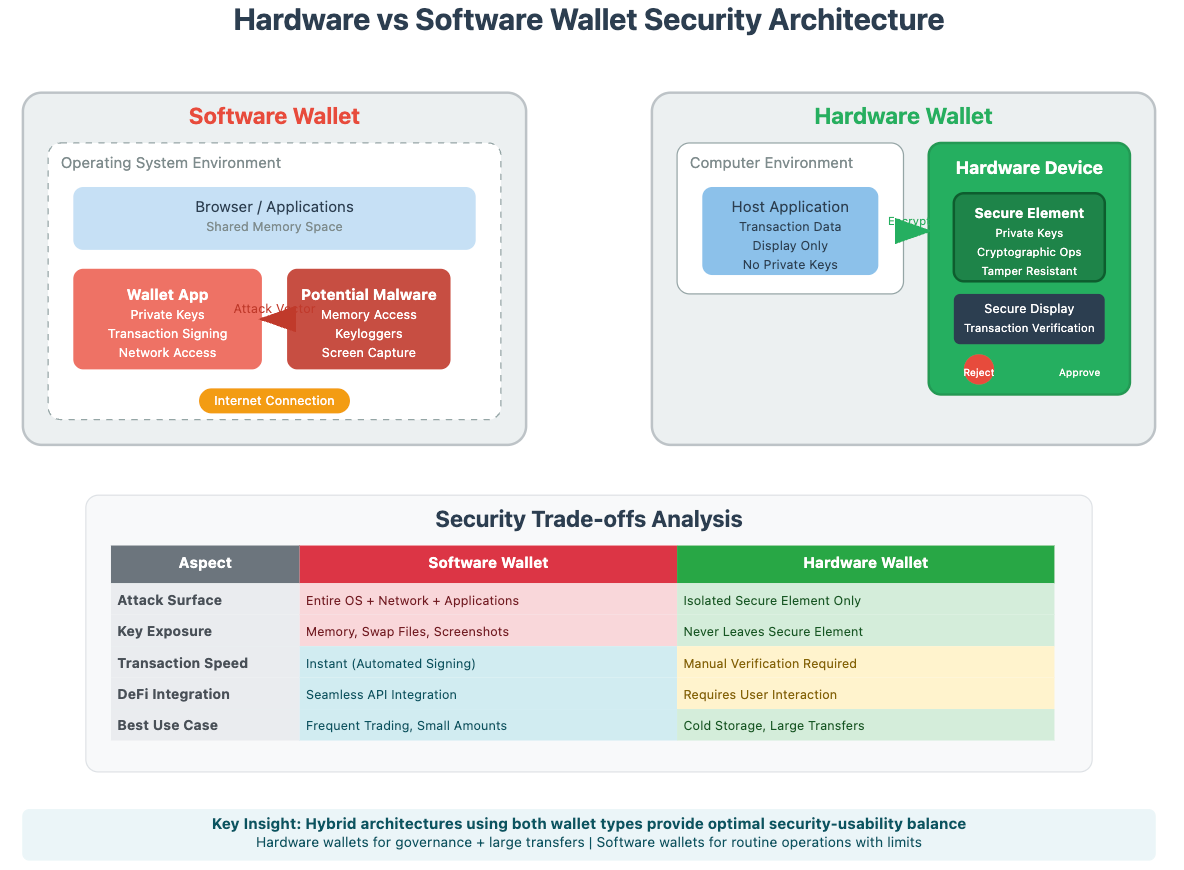
The Fundamental Security Model Divergence
Hardware and software wallets operate on fundamentally different security assumptions that create cascading implications for your entire system architecture. Software wallets prioritize accessibility and integration speed, storing private keys in your device's memory space where they share the same attack surface as every other application. Hardware wallets implement physical isolation, creating an air-gapped environment where private keys never leave a dedicated secure element.
The critical insight most engineers miss is that this isn't just about key storage—it's about the entire transaction signing workflow. In software wallets, the signing process occurs in your computer's general-purpose operating system, where malware can potentially observe or modify transaction data before signing. Hardware wallets perform cryptographic operations inside tamper-resistant chips, making transaction details immutable once displayed on the device screen.
Attack Vector Analysis: Where Theory Meets Reality
Consider three real-world scenarios that reveal the nuanced security trade-offs. When Ethereum's London fork introduced EIP-1559, many developers rushed to update their automated trading systems using hot wallets for speed. What they didn't anticipate was malware specifically targeting the new transaction format, modifying gas parameters to drain funds through artificially inflated priority fees.
The Ronin Network breach demonstrated how convenience-focused architectures create systematic vulnerabilities. Their validators used software wallets for operational efficiency, making it possible for attackers to compromise multiple validators through coordinated social engineering attacks. A hardware wallet requirement would have forced physical access to each validator location, dramatically reducing the attack's feasibility.
Conversely, the recent Wintermute hack showed how hardware wallet adoption without proper operational security creates false confidence. The team used hardware wallets for cold storage but maintained software-based hot wallets for algorithmic trading, allowing attackers to drain active funds while cold storage remained secure.
The Composability vs Security Paradox
Modern DeFi protocols demand high-frequency interactions that create interesting architectural challenges. Hardware wallets introduce latency that can be devastating in MEV-sensitive environments. I've seen arbitrage bots lose $500K in opportunities waiting for hardware wallet confirmations during volatile market conditions.
The emerging solution involves hybrid architectures where protocols implement tiered security models. Critical operations like governance votes and large transfers require hardware wallet signatures, while routine operations use software wallets with strict spend limits and time-based restrictions. This approach acknowledges that perfect security often conflicts with operational requirements.
Implementation Strategies for Production Systems
The most effective approach I've observed combines hardware wallet security with software wallet flexibility through a custom authorization layer. Smart contracts can verify signatures from both hardware and software wallets, implementing different trust levels based on the signature source.
For example, a DeFi protocol might allow unlimited withdrawals with hardware wallet signatures but restrict software wallet signatures to 1% of total balance per day. This creates a practical security gradient that matches operational needs while maintaining strong security for high-risk operations.
The key insight is that wallet security isn't binary—it's a spectrum that should align with your risk tolerance and operational requirements. Teams that understand this nuance build more resilient systems than those pursuing absolute security at the expense of functionality.
Practical Implementation: Secure Multi-Signature Architecture
Here's a production-ready approach that balances security with operational efficiency:
contract SecureMultiSig {
    mapping(address => uint256) public walletTypes; // 0: software, 1: hardware
    mapping(address => uint256) public dailyLimits;
    mapping(address => uint256) public lastTransactionTime;

    modifier requiresHardwareWallet(uint256 amount) {
        require(amount > HARDWARE_THRESHOLD ||
                walletTypes[msg.sender] == 1,
                "Large amounts require hardware wallet");
        _;
    }

    function executeTransaction(uint256 amount)
        external
        requiresHardwareWallet(amount) {
        // Implementation ensures hardware wallets bypass daily limits
        // while software wallets face restrictions
    }
}
This architecture acknowledges that perfect security is less valuable than appropriate security matched to operational context. The most successful teams I've worked with implement graduated security models that scale with transaction importance rather than applying uniform restrictions across all operations.
Your wallet security architecture should reflect your system's actual risk profile, not theoretical maximum security. Understanding these trade-offs enables you to build systems that are both secure and practical for your specific use case.
Next week: "Smart Contract Upgradeability Patterns: Security Implications of Proxy Architectures"