

Cryptocurrency for Beginners: Complete 2025 Guide to Digital Assets
Welcome to the Crypto Revolution
Remember when the internet seemed like a passing fad? Cryptocurrency stands at that same crossroads today. What began with Bitcoin in 2009 has blossomed into a financial ecosystem that's reshaping how we think about money, ownership, and value exchange.
This guide isn't just about understanding crypto—it's about empowering you to participate in the digital economy with confidence.
What Is Cryptocurrency, Really?
At its core, cryptocurrency is digital money that uses cryptography for security. Unlike traditional currencies issued by governments (fiat), cryptocurrencies operate on decentralized networks using blockchain technology.
Think of blockchain as a digital ledger where transactions are recorded chronologically and publicly. Each "block" contains a batch of transactions, and once verified by network participants (miners or validators), it's added to the "chain" permanently.
How Cryptocurrency Transactions Work
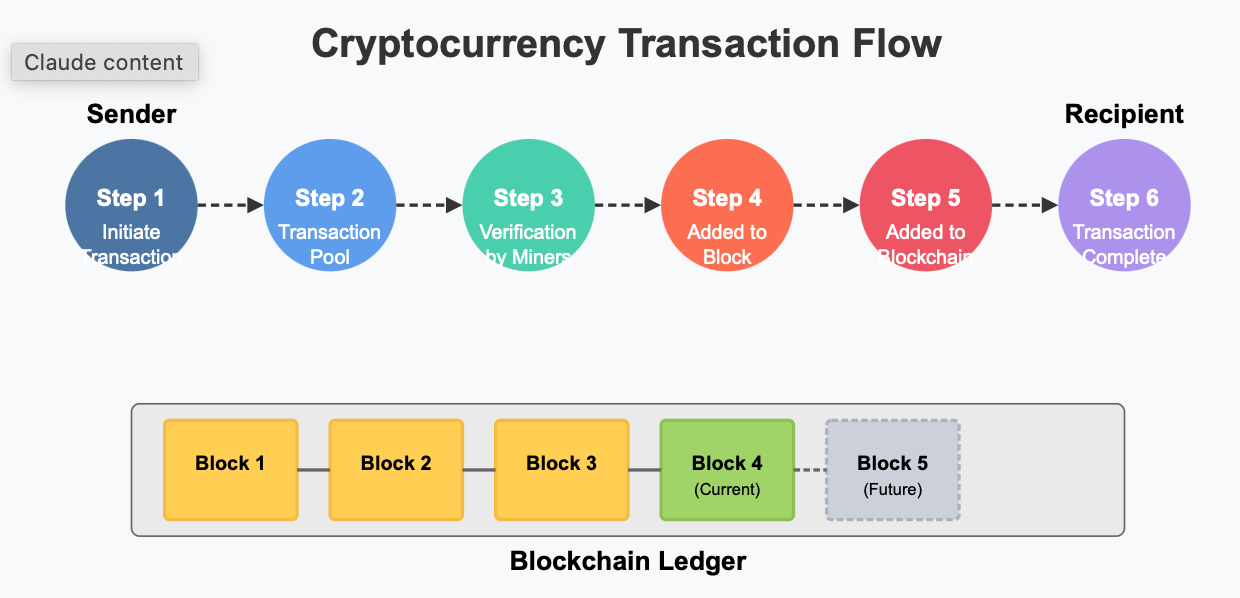
Let's break down what happens when you send Bitcoin to a friend:
You initiate a transaction from your wallet
The transaction joins a pool of pending transactions
Miners/validators verify the transaction's legitimacy
Your transaction gets added to a new block
The block is added to the blockchain
Your friend receives the Bitcoin
Here's what this process looks like:
Your First Crypto Purchase: A Step-by-Step Guide
Ready to own some cryptocurrency? Here's how to get started:
Choose an exchange - Binance, Coinbase, and Kraken remain popular in 2025. For beginners, look for intuitive interfaces and strong educational resources.
Complete verification - Most exchanges require identity verification to comply with regulations. This typically involves submitting photo ID and proof of address.
Connect payment method - Link your bank account or debit card. Some exchanges accept credit cards, but beware of higher fees.
Make your purchase - Start small! Even $20 worth of Bitcoin or Ethereum gives you skin in the game without risking too much.
Consider secure storage - While keeping assets on exchanges works for beginners, hardware wallets offer superior security for larger holdings.
Beyond Bitcoin: The Evolving Crypto Landscape
While Bitcoin remains the flagship cryptocurrency, the ecosystem has diversified:
Ethereum continues revolutionizing finance through smart contracts and dApps
Layer-2 solutions have addressed scalability concerns
Central Bank Digital Currencies (CBDCs) have gained adoption across major economies
DeFi protocols provide banking services without traditional intermediaries
NFTs have moved beyond digital art into practical identity verification and ownership systems
Real-World Applications Taking Hold
Cryptocurrency isn't just for speculation anymore. Here are concrete examples of crypto solving real problems in 2025:
Cross-Border Payments
Maria, a software developer in Argentina, receives payments from her US clients in stablecoins, bypassing currency controls and saving approximately 12% in traditional banking fees. The transaction settles in minutes rather than days.
DeFi Lending
Farmers in Kenya access microloans through DeFi platforms without meeting traditional banking requirements. Smart contracts automatically distribute funds when collateral conditions are met, with typically 40% lower interest rates than local alternatives.
Supply Chain Transparency
Consumers now scan QR codes on premium products to view blockchain-verified journeys from production to purchase. This has reduced counterfeit luxury goods by an estimated 30% since 2023.
Building Your Knowledge Foundation
The crypto learning curve can feel steep, but approach it like building blocks:
First month: Master basic transactions and security principles
Second month: Understand different blockchain technologies and tokenomics
Third month: Explore specialized areas matching your interests (DeFi, NFTs, etc.)
Each small victory—completing your first transaction, setting up secure storage, explaining concepts to friends—represents genuine progress. Don't rush the journey.
Looking Forward
As cryptocurrency adoption accelerates, we're witnessing the emergence of a parallel financial system that's increasingly integrated with traditional finance. Whether cryptocurrency ultimately complements or disrupts conventional systems, understanding this technology gives you agency in a rapidly changing economic landscape.
The knowledge you gain today isn't just about potential investment returns—it's about participating in one of the most significant technological shifts of our lifetimes.